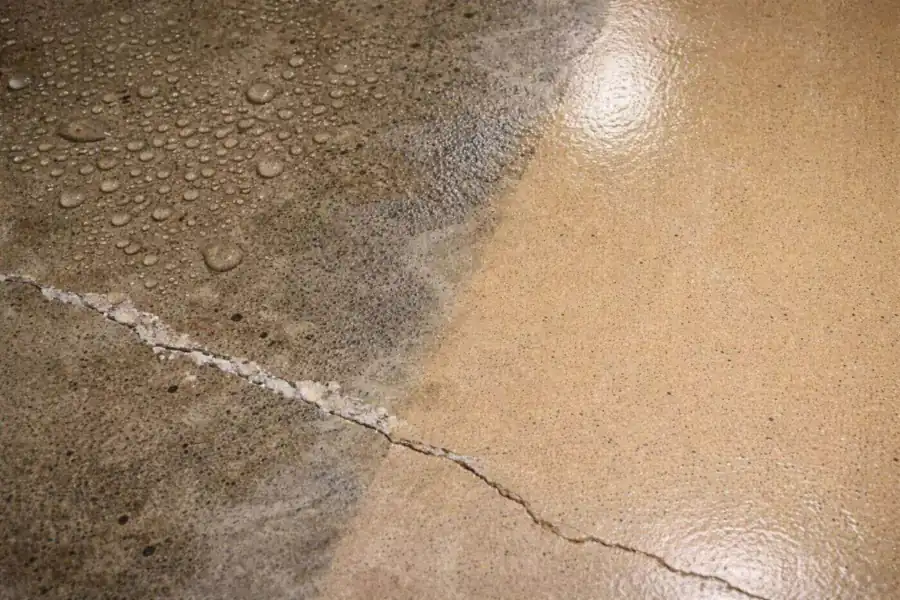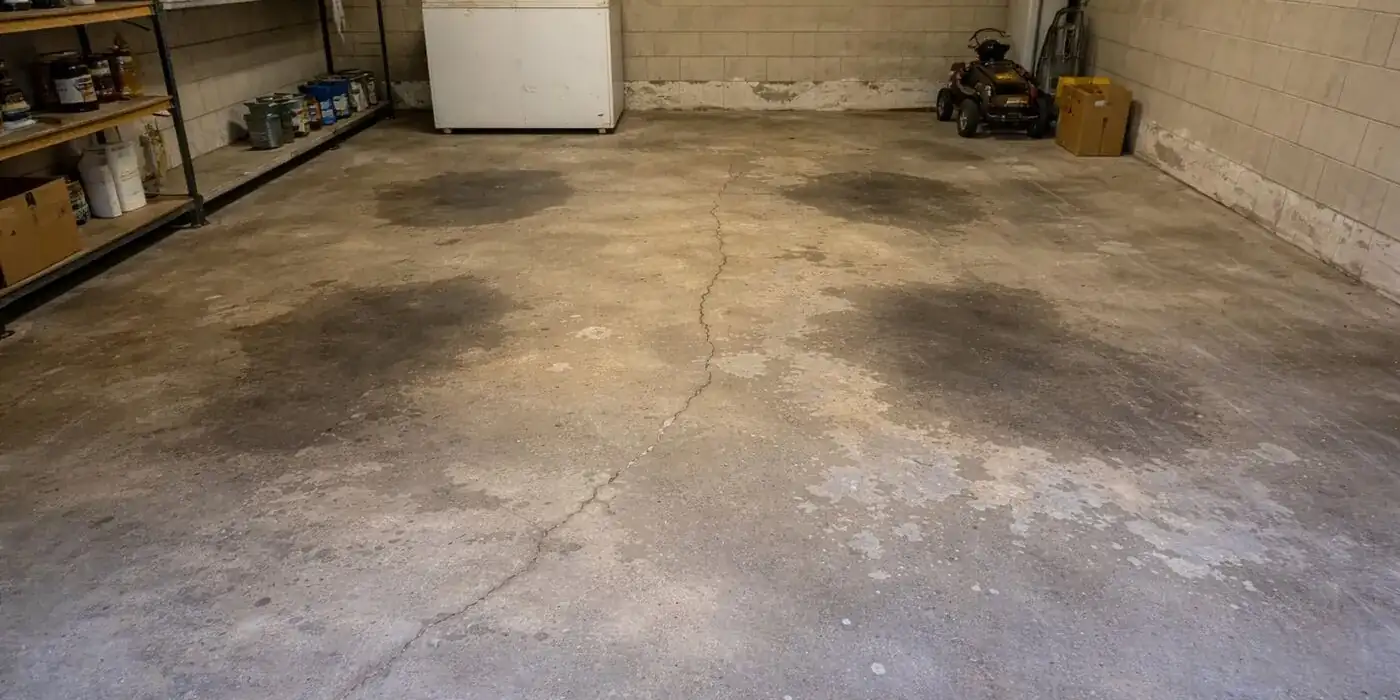
Look at enough failed garage coatings and a pattern jumps out. The damage starts at the door: a strip a foot or two deep where the finish chips, curls and lifts, while the floor behind it, under the cars and along the walls, still looks close to new. Just outside, the bare concrete apron often shows its own version of the problem, a rough, flaking surface where the top layer has scaled away. In Salt Lake County both come from the same mix of de-icer slush, freeze–thaw and traffic, and both are largely preventable.
Why the Threshold Goes First
No part of a garage floor works harder than the threshold:
- Slush lands there first. Snowmelt laced with salt, magnesium chloride and road grime drips off the tires as soon as the car stops. The National Ready Mixed Concrete Association points out that magnesium-based de-icers get tracked in by cars and build up on concrete surfaces.
- Water drains toward it. Garage floors are built with a slight fall toward the vehicle door or a drain, as building codes require, so meltwater ends up pooling at the threshold.
- It sees the most freeze–thaw. By NOAA’s normals, the airport averages about 112 nights a year at or below freezing, and most of those afternoons warm back above 32°F. Every time the door opens, that edge meets the outside air, and Salt Lake City’s building code rates concrete weathering exposure here as “severe.”
- Every tire crosses it. Wheels turn and brake on that strip, carrying summer heat in July and wet grit in January.
So a coating with a weak point fails at the door before anywhere else. Four weak points account for most of it.
Cause 1: A Slab That Was Never Ground
Epoxy bonds mechanically: it needs an open, slightly rough surface to key into. Trowel-finished concrete is dense and smooth to begin with, and years of dust, tire dressing, oil and old sealer make it worse. Floors that fail early were often only washed before coating, or done with a store-bought kit spread over whatever was already on the slab.
That is the reason every garage floor is diamond ground first. The grinder strips the soft surface paste, sealers and contamination and exposes clean, porous concrete the base coat can penetrate. Cracks, broken joint edges and spalls are filled during the same step.
Cause 2: Moisture Pushing Up From Below
Slabs sit on soil, and soil holds water. If vapor keeps rising through the concrete after it has been coated, pressure builds under the film until it blisters or lets go, and a free edge is the easiest place for that to start. Low spots where meltwater pools by the door, and slabs on wetter ground, are the most likely candidates. The Utah Geological Survey has mapped shallow groundwater on the west side of the Salt Lake Valley, so it pays to check rather than assume.
So before anything is applied, the slab gets a moisture check. If there is a real water problem, such as drainage running under the slab, it needs fixing at its source; coating over it would only delay the failure.
Cause 3: Hot Tires on a Weak Bond
The airport averages about 62 days a year at 90°F or hotter, and July’s normal high is 94°F. Drive home on I-15 or Bangerter Highway on one of those afternoons and the tires that roll onto the threshold are hot and soft. On a coating that was poorly bonded or applied too thin, hot rubber can grip the surface as it cools and lift it, a failure known as hot-tire pickup. It points to weak prep far more than to summer itself.
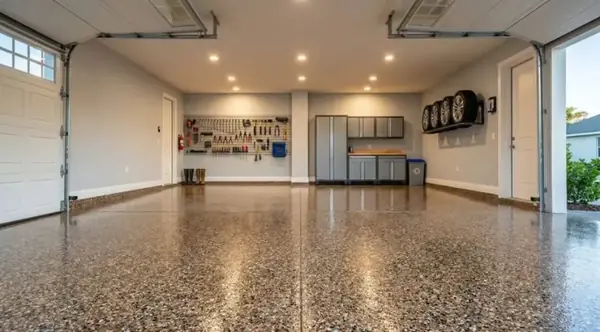
What goes on top still matters. Flake floors are built with a slab-penetrating epoxy base coat, a full broadcast of vinyl flake and a high-impact, UV-resistant protective topcoat; polyaspartic systems are also available. Slip-resistant additives can go into the finish, which is worth having on the wet, slushy strip by the door. Even on a well-built floor, hot rubber can leave marks, and those should be cleaned as they appear. The differences between coatings are covered in epoxy vs. polyaspartic.
Cause 4: De-Icers and Freeze–Thaw Under an Edge
Salt Lake City spreads 16,000 to 20,000 tons of salt on its streets each winter, Herriman sprays salt brine before snowfall, and magnesium chloride is a common choice for driveways and sidewalks. A coating that is fully bonded keeps all of it on the surface. The trouble begins at a break: a chipped spot, a feathered edge at the door seal, a patch that never bonded. Salty water seeps in, freezes overnight, thaws by afternoon and wedges the coating up a fraction more each cycle. That’s why so many threshold failures surface after one or two winters. The flaw dates from the install; the cold just exposes it.
The apron outside the door is a separate story. It is bare concrete, and the NRMCA explains that scaling, the flaking or peeling of a concrete surface, is driven by freeze–thaw and made worse by de-icing chemicals, especially on concrete that was poorly finished or cured, or heavily salted while still new. A garage floor coating inside does nothing for the apron. Sealing for driveways, patios and walkways is available, and it is worth asking about at the estimate.
Seeing Lifting by the Door?
Book a free on-site look and find out whether a spot repair will do or the floor needs a full recoat, with no obligation.
What to Ask Before You Hire Anyone
- “What will you do to the concrete before coating?” Diamond grinding plus crack and joint repair is the answer you want; a wash alone isn’t enough.
- “Do you test for moisture, and what happens if the slab is damp?” Expect a yes and a clear next step.
- “Which topcoat, and why for a garage?” The reasoning should cover sun, hot tires and salty slush.
- “How do you handle the edge at the door?” The threshold deserves its own answer, separate from the middle of the floor.
To see what sets the price of a full system, read the Salt Lake City epoxy cost guide.
How the Threshold Gets Built
- Look over the whole slab and the door edge for old coating, scaling and cracks.
- Run a moisture check.
- Diamond grind the whole floor, right out to the door edge.
- Rebuild cracks, broken joints and scaled patches until the edge is sound.
- Apply the epoxy base coat and broadcast the flake, if you chose a flake floor.
- Seal it with the UV-resistant protective topcoat, adding slip resistance if you ask for it.
Most garage floors are installed over about two days. The crew tells you when you can walk on the floor and when the car can come back in.
Repairing a Peeling Threshold
Most peeling thresholds can be saved, but not by painting over them; new material on top of loose coating fails along with it. The repair cuts the coating back to where it is still tight to the slab, grinds and patches the exposed concrete, and recoats the strip so it ties into the existing floor. When the lifting runs across much of the floor, or moisture is behind it, stripping the old coating completely, by shot blasting or diamond grinding, and starting fresh is usually the sounder choice. You’ll hear which applies once the floor has been seen. The repair and recoat service page has more detail.
Frequently Asked Questions
Why is my garage coating lifting near the door?
That strip gets more slush, de-icer, freeze–thaw and tire traffic than any other part of the floor. A weak bond, rising moisture or a thin coat gives way there first, and water freezing under the loose edge keeps pushing it up.
How long before a badly installed floor starts to peel?
There’s no fixed timeline, but peeling at the door commonly appears in the first year or two, often right after a winter, once salty meltwater reaches a flaw left at installation.
Which topcoat suits the strip by the garage door?
Flake floors get a high-impact, UV-resistant protective topcoat over the epoxy base coat, and polyaspartic systems are available too. By the door, though, the bond to the concrete counts as much as the topcoat, and that bond comes from diamond grinding.
Is road salt to blame for the peeling?
Seldom by itself. Salt and magnesium chloride exploit a poor bond, a chip or an open edge. A well-prepared floor keeps them on the surface, where they rinse away.
Why is the concrete outside my garage door flaking?
That is scaling of bare concrete, driven by freeze–thaw and made worse by de-icing chemicals. A garage floor coating does not cover the apron outside. Exterior concrete sealing is available; ask about it at your free estimate.
Can the peeling strip be fixed without redoing the whole floor?
Often, yes. Loose coating is cut back to where it is firmly bonded, the slab is ground and patched, and the strip is recoated. If the failure is widespread or moisture is involved, a full strip and recoat is usually the better call.