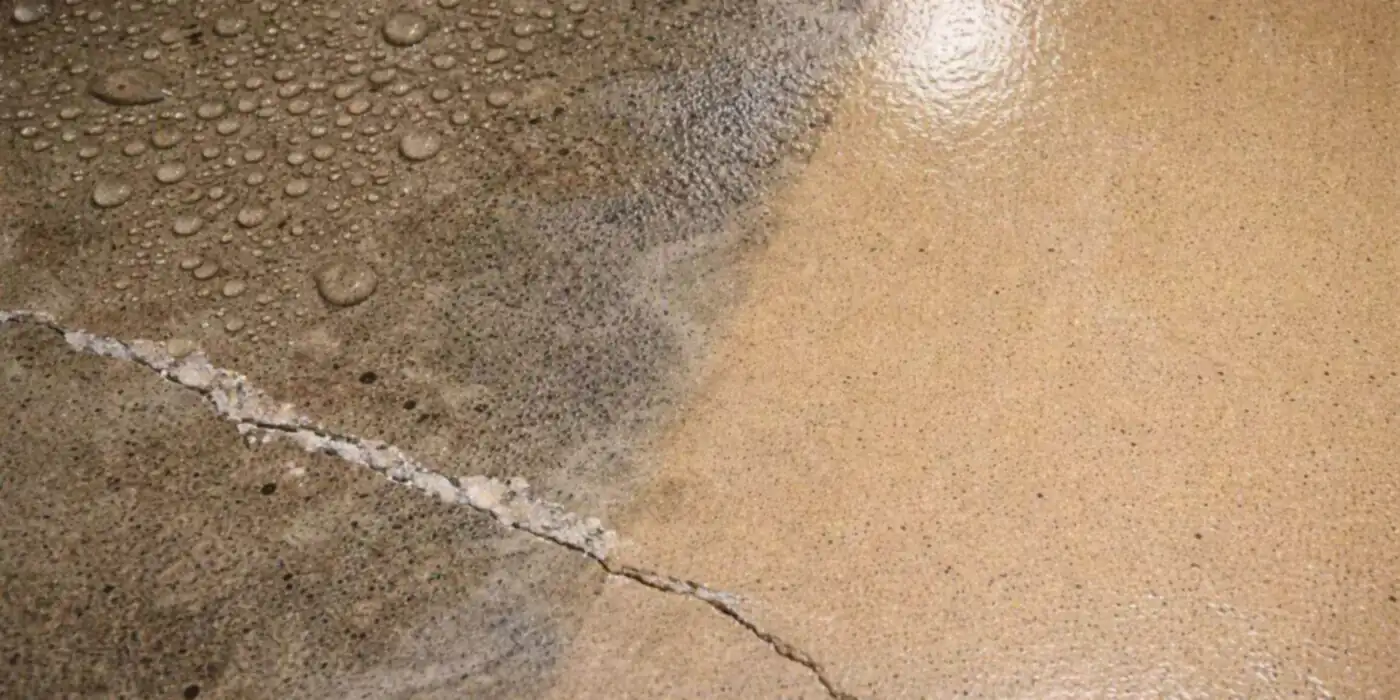
Ask around about garage coatings and you'll hear strong opinions on epoxy versus polyaspartic, often from people who sell only one of them. Both are two-part coatings that cure into a hard, protective film on concrete, and both can make a good floor. They behave differently, though, and a Salt Lake County garage asks a lot of a coating: road salt from November into April, very dry summer heat, and strong sun at altitude. Here is a plain comparison, so you can ask better questions at your estimate.
What Epoxy Brings to a Floor
Epoxy is a resin and a hardener mixed on site. Once it cures, it forms a hard, dense layer that bonds tightly to properly prepared concrete. What it does well:
- Grip on the slab. On concrete that has been diamond ground, epoxy bonds strongly, which is why it is so often the base of a floor system.
- Build. It can go on relatively thick, which helps even out small surface flaws.
- Decorative range. It carries flake, metallic pigment and solid color well, and it gives the installer time to work the material, which matters for a hand-worked metallic finish.
Its limits matter in a garage. Standard epoxy can amber over time in strong sunlight, its surface can scuff, and it is slow to cure when the concrete is cold. That last point counts in a valley where the normal January low is about 24°F and an unheated garage slab stays cold well into the day.
What Polyaspartic Brings
Polyaspartic is a newer coating chemistry from the polyurea family. It is usually chosen for a few traits:
- Faster cure. It generally sets much faster than epoxy, so coats can follow one another sooner.
- Sun resistance. Polyaspartic topcoats are generally more resistant to UV than standard epoxy, which is why they are often used as the final layer.
- A hard-wearing surface. It is commonly used on top because it stands up well to scuffing and to many household chemicals.
The trade-offs: the fast set leaves less working time, so it has to be mixed and spread quickly by a crew that knows the product, and the product's own instructions on temperature and timing still apply. Like any coating, it is no fix for a damp slab; moisture still has to be checked first. Polyaspartic systems are available through our installer, alongside epoxy flake, metallic and solid-color floors.
The Two Side by Side
| Feature | Epoxy | Polyaspartic |
|---|---|---|
| Cure speed | Slower; more time between coats | Generally much faster |
| Working time | Generous; suits hand-worked finishes | Short; needs an experienced crew |
| Sunlight | Standard epoxy can amber over time | Generally more UV-resistant |
| Cold slabs | Slow to cure on cold concrete | Still bound by the product's temperature limits |
| Build per coat | Can go on thick | Usually thinner |
| Decorative layers | Carries flake, metallic and solid color | Usually the clear layer over them |
| Typical role | Base and color coats | Topcoat |
Try finishes on a floor like yours and get a typical Salt Lake County price range with your free-estimate request.
Open Floor Studio →What the Valley's Weather Asks of a Coating
Salt Lake County pushes a garage floor from both directions. NOAA's 1991–2020 normals for the airport show about 112 nights a year at or below freezing and about 62 days at 90°F or hotter.
Winter: salt, slush and cold slabs
Salt Lake City alone spreads 16,000 to 20,000 tons of salt on its streets in a typical winter, and Herriman sprays salt brine on its roads before snow arrives. That salty slush rides home on your tires and drips onto the slab. On bare concrete it soaks in, and the concrete industry group NRMCA notes that de-icers make freeze-thaw scaling worse. A coating with a firm grip on the slab keeps it on the surface, where it can be squeegeed out and rinsed off. Here the bond and the edges matter more than the label on the topcoat, because salt water that gets under a chipped edge does the damage.
Cold slabs are the other winter factor. Every coating has a temperature range on its data sheet, and an unheated garage in January may sit outside it. A careful crew checks the slab temperature, not just the air, and schedules around the product's instructions.
Summer: dry heat and strong sun
July's normal high at the airport is 94°F, and afternoons are very dry. Heat shortens the working time of fast-setting products, which is one more reason the crew follows the product's instructions instead of rushing. Altitude adds sun: the valley floor sits at roughly 4,200 feet, and the EPA puts the rise in UV intensity at about 6 percent per kilometer of elevation. Any floor near an open door or a sunny window gets that light, which is why flake floors here are finished with a UV-resistant protective topcoat.
Basements are a different case
A basement gets little sun, no salt slush from tires and steadier temperatures. The case for a sun-resistant topcoat is weaker there, and an epoxy system in flake, metallic or solid color can make a good basement floor once the slab has been checked for moisture.
Base Coats, Topcoats and Systems
The epoxy-or-polyaspartic question is often a false choice, because a floor is built in layers. On the installer's flake floors the build-up runs like this: diamond-ground slab preparation, a slab-penetrating epoxy base coat, a full broadcast of vinyl flake, and then a high-impact, UV-resistant protective topcoat. The base coat does the bonding; the flake adds color and texture and disguises everyday dust; the topcoat takes the sun, the scuffs and the slush.
So the more useful questions at your estimate are what goes down as the base, what goes on top, and why for your floor. Ask what the topcoat is, which sheen you'd like (matte, semi-gloss or high-gloss), and whether a slip-resistant additive makes sense where the floor gets wet.
Price depends on your slab more than on product names: size, cracks, old coatings and the finish all change the work, so it's set after a free on-site visit. The cost guide explains what moves it.
Whatever the cans say, the prep underneath decides how the floor performs, and every garage floor is diamond ground first.
Unsure Which System Suits Your Floor?
Book a free on-site estimate. The installer looks at the slab and how you use the space, then recommends a system and explains why.
Urethane Cement and Other Options
Epoxy and polyaspartic aren't the whole menu:
- Urethane cement is a heavy-duty commercial system for hot, wet rooms such as restaurant kitchens, where hot water and constant cleaning would punish a thinner coating. It is a business-floor product, not a garage one.
- Solid-color epoxy suits workshops, storage rooms and utility spaces where a clean, even color matters more than pattern.
- Metallic epoxy is the decorative choice for basements, showrooms and home bars, with many metallic colors to pick from.
Slip-resistant additives are available for floors that get wet, whichever system you choose.
Choosing Room by Room
Attached or detached garage
Usually flake over an epoxy base with a protective topcoat. This floor sees sun through the open door, salt slush all winter and fluids all year, and the layered system is built for that mix. Detached garages are often unheated, so the slab temperature matters more when the work is scheduled.
Basement
An epoxy system in solid color, flake or metallic, after a moisture check. Ask about a harder-wearing topcoat if the room will see heavy use, such as a home gym or a playroom.
Workshop or home gym
A solid-color or flake floor with a tough topcoat, plus a slip-resistant additive where the floor may get wet.
Business floors
It depends on traffic, chemicals, heat and how long the space can close. Urethane cement suits hot, wet kitchens; showrooms often go metallic. Commercial floors are quoted per project after a site visit.
Frequently Asked Questions
Is polyaspartic better than epoxy for a Salt Lake City garage?
Neither wins on its own. Epoxy makes a strong base that bonds well to ground concrete; polyaspartic is often used on top because it generally handles sun and scuffs better. A garage floor is built in layers, so ask what goes on top of yours and why.
Can either coating be installed in winter?
Often, yes, but the slab has to be inside the product's temperature limits, and an unheated garage in January may not be. The crew checks the concrete temperature, not just the air, and schedules around the product's instructions.
Which one handles road salt better?
Both resist salt water when they are well adhered. What matters most is good prep and sound edges, because salt slush that gets under a chipped edge does the damage. Squeegee and rinse the area inside the door through the salt season.
How long does installation take?
Most garage floors are installed over about two days. When the floor can take foot traffic and a car depends on the products and the conditions, and the installer will tell you for your floor.
Will sunlight yellow my floor?
Standard epoxy can amber over time in strong sun, and the sun is stronger at our elevation than at sea level. That's why flake floors here are finished with a UV-resistant protective topcoat.
How much does each system cost in Salt Lake City?
It depends on the size of the floor, the condition of the slab and the finish you choose, so every floor is priced after a free on-site visit, with no obligation.
Related Articles
Epoxy Flooring Cost in Salt Lake City: What Sets Your Price (2026)
What sets the price of a garage or basement floor in Salt Lake City, and what pushes a quote up or down.
How Salt Lake City’s Snow, Salt and Sun Test an Epoxy Floor
Freezing nights, road salt, dry summer heat and strong sun: what each one means for a coated floor.
Is Epoxy Flooring Worth It in Salt Lake City? Pros and Cons
The real pros and cons of a coated floor for a Salt Lake County home, and when we'd suggest waiting.