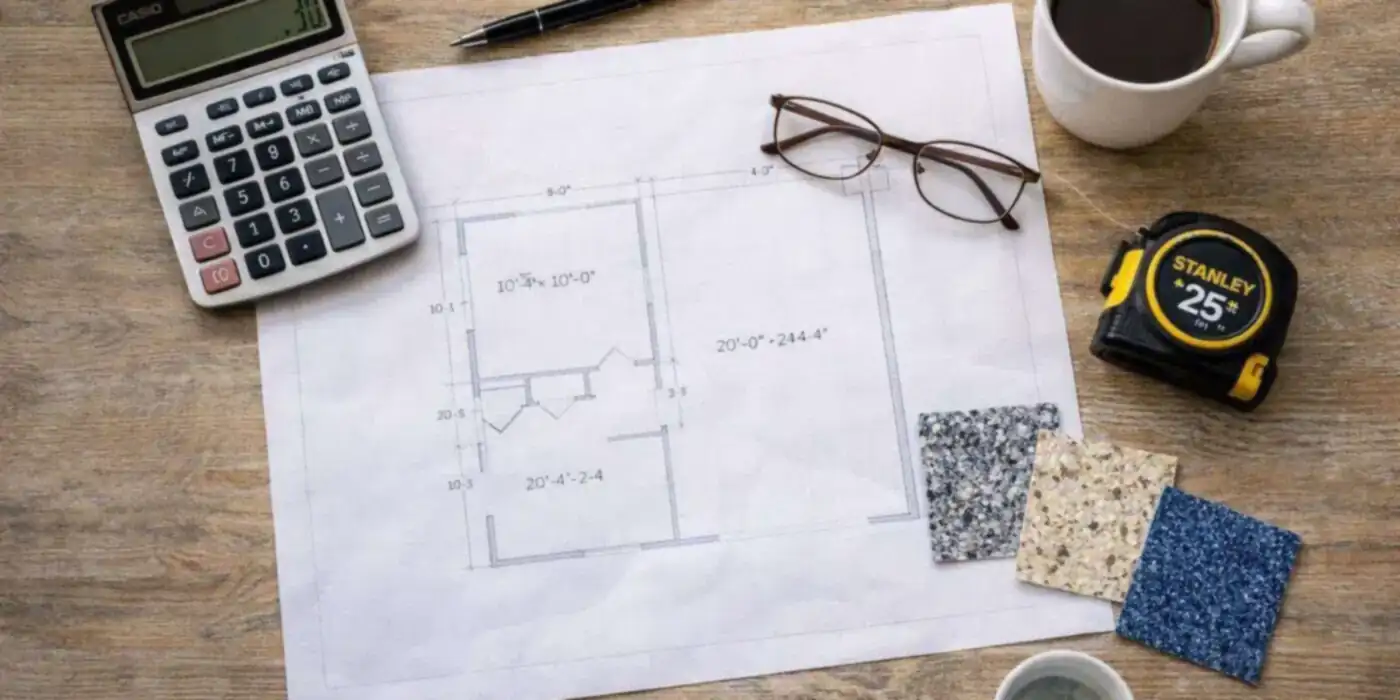
Ask three installers what an epoxy floor costs and you may hear three different answers, and none of them means much until someone has looked at your slab. Two garages with the same footprint can need very different amounts of work. That is why every Salt Lake City floor we coat is priced after a free on-site visit, and why this guide explains the factors behind a price rather than printing figures.
Below are the factors that move a quote up or down, how the age of a Salt Lake County house shows up in its concrete, what changes for basements and business floors, and how the free estimate works. If you would like to play with colors and finishes first, Floor Studio lets you try them on screen.
The Price Factors in One Table
| What the installer looks at | Why it changes the price |
|---|---|
| Size of the space | More square feet means more material and more hours. A two-car garage is often around 400 to 500 square feet. |
| Slab condition and repairs | Cracks, spalls, pitting, oil and salt-scaled patches near the door are ground out or filled before any coating goes on. |
| Moisture | The slab is checked first. A water problem has to be dealt with at its source before a floor goes down. |
| System and finish | Flake, metallic and solid-color epoxy build differently, and you choose the flake color, flake density and topcoat sheen. |
| Prep and coating removal | Every garage floor is diamond ground. Old paint or an old coating comes off first, by shot blasting or diamond grinding. |
| Access and layout | Stairs down to a basement, steps, drains, posts and tight corners all add hand work. |
Try finishes on a floor like yours and get a typical Salt Lake County price range with your free-estimate request.
Open Floor Studio →Why no price list? A printed number has to assume an average slab: sound concrete, a little crack filling, nothing to strip. Plenty of floors in Salt Lake County don’t match that picture, in either direction. A garage with a peeling kit coating and salt-scaled concrete by the door takes more work than a clean slab in a house finished a few years ago. The figure worth planning around is the one the installer quotes once the floor has been seen.
Garage Size: Why Square Footage Isn’t the Whole Story
Square footage is the biggest single driver, but the price doesn’t climb in a straight line with it. Part of every job costs about the same whatever the size: bringing in the grinder and dust collection, masking the walls and the door track, and the waiting time between coats. Most garage floors are installed over about two days, so a one-car garage carries that setup on fewer square feet and costs more per foot than a large three-car garage.
To get a useful conversation going on the phone, have a few details ready:
- Length and width, wall to wall, counting the strip beneath the garage door.
- Anything that has to stay where it is: built-in cabinets, a bolted-down workbench, a water heater or furnace sitting on the slab.
- What the floor looks like today: bare, painted or coated before, plus any cracks, oil spots or flaking near the door.
None of that replaces the visit, but it helps the installer plan it and spot what needs a closer look.
Basement Floors: Checked for Moisture, Then Priced
A basement floor goes through the same steps as a garage: grinding, crack repair and the coating system you choose. With no car parked on it, a basement is a natural place for a metallic or solid-color finish. What a basement price never covers is a water problem.
Concrete below grade is in contact with the ground, which is why every basement slab gets a moisture check before it is priced. Parts of the valley give good reason to look: the Utah Geological Survey has mapped shallow groundwater, meaning a water table within 20 feet of the surface, across the west side of the Salt Lake Valley and warns that it can flood basements. If the slab reads dry, nothing changes. If it doesn’t, the water has to be dealt with at its source first, and that is a drainage or foundation job rather than a flooring one.
A floor coating does not waterproof a basement, and nobody should sell it as one. Its job is to make a dusty, porous slab easy to sweep, mop and keep clean.
Five Factors Behind a Salt Lake City Quote
1. How old the slab is and what it has been through
Concrete that has carried cars through many Utah winters usually has more to fix: hairline cracks, chipped joints, oil soaked deep into the surface, and scaled patches near the door where salty slush sat and froze. Each repair is hand work before coating starts. Hairline cracks are normal in concrete and are filled during prep; the coating itself is not a crack cover.
New concrete has its own catch. Fresh concrete needs to cure fully before coating, for as long as the coating maker’s instructions require, and builders often finish new garages with a curing compound or sealer that must be ground away. Building a new home in Herriman or South Jordan? Call before move-in so the schedule lines up.
2. Moisture in the slab
Vapor coming up through the slab ranks among the top reasons coatings fail, so the slab is checked before anything is priced. A dry slab adds nothing. A slab with a water problem gets that problem named and dealt with before a floor goes down, rather than coated over and left to fail.
3. Size, shape and access
Beyond raw square footage, layout matters. Steps into the house, a floor drain, support posts, a slab that runs under built-in cabinets, or a basement reached by a narrow stairway all slow the work. A simple open rectangle is the quickest shape to coat; a basement split into several small rooms takes longer.
4. The system and finish you choose
Flake floors are the usual garage choice: an epoxy base coat, a full broadcast of vinyl flake in the color and density you pick, and a protective, UV-resistant topcoat. Solid-color epoxy is a simpler build. Metallic epoxy, offered in many metallic colors, takes more hand work and suits basements and showrooms. Topcoats come in matte, semi-gloss or high-gloss, polyaspartic systems are available, and slip-resistant additives can go into the finish. Each choice changes the material and labor a little, and the quote prices exactly what you pick.
5. Prep: grinding and coating removal
Every garage floor is diamond ground before coating, so grinding is part of every price. The variable is what has to come off first. A bare slab grinds quickly. A garage with old paint, a peeling kit coating or a sealer needs that layer removed, by shot blasting or diamond grinding, before the new system can bond. If you know your floor was coated before, mention it when you call.
Want an Exact Price for Your Floor?
Book a free on-site estimate. The installer measures, checks the slab and gives you an exact price, with no obligation.
Old City Slabs, 1970s Suburbs and New South-Valley Builds
Salt Lake County has no single housing stock, and its concrete shows it. Census figures (American Community Survey, 2020–2024) put the county’s median home at 1986, but that middle hides a wide spread:
- Salt Lake City itself. About a quarter of the city’s homes were built before 1940, and the Avenues has been a local historic district since 1978. Older garage and basement slabs tend to need more crack and joint repair, and some carry layers of paint or patching from earlier owners.
- Millcreek and Holladay. Their single biggest building decades were the 1950s and 1960s, so many slabs here are post-war concrete: usually solid but stained, and possibly carrying an old paint or sealer layer.
- Murray, Taylorsville and Sandy. Murray’s busiest building decade was the 1970s, Taylorsville is mostly 1970s and ’80s homes, and Sandy, Utah, mixes 1970s houses with a good share from the 1980s and ’90s. These garages have seen plenty of winters, so check the strip inside the door for wear and scaling.
- The south and west valley. West Jordan’s median home dates to 1995, Draper’s to 2003 and South Jordan’s to 2007; Daybreak opened there in 2004. In Herriman the median is 2013, and about 91 percent of homes were built in 2000 or later. A younger slab that has never been coated is often the most straightforward job.
These are city-wide medians, and your own house can be older or newer than the city figure. Either way, it is the condition of your slab, not your ZIP code, that drives the number.
Will the Time of Year Affect the Price?
Not much, but it shapes the schedule. At Salt Lake City International Airport the median first freeze arrives around October 31 and the last around April 8, and the same station averages about 62 days a year at 90°F or hotter (NOAA 1991–2020 normals). Coatings react to both extremes. On a hot, very dry July afternoon, mixed material can set faster than usual, so it goes down in smaller batches; in a cold garage in January, curing slows. Installers work to the slab temperature and the product’s own instructions, and a winter job may simply be booked around a milder stretch. How the two main coatings behave in heat and cold is covered in epoxy vs. polyaspartic.
Commercial Floors Are Quoted Per Project
Business floors vary too much for any single figure to help. A retail showroom, an auto shop service bay, a restaurant kitchen and a warehouse each need a different system and different prep. Kitchens hit with hot water and daily washdowns are candidates for urethane cement. Warehouses with forklifts tend to need a heavier build, sealed joints and painted aisle lines. Showrooms lean toward flake or metallic finishes, and wet or greasy work areas can get a slip-resistant texture.
The installer walks the site, studies the slab and how the space is used, and prices the project from there. Let us know how much downtime you can live with and the schedule is built around it. See the commercial flooring page for the systems available.
How the Free Estimate Works
- Call or send the form. The phone is answered 24/7. Say which room it is, roughly how big, and what bothers you about the floor now.
- The on-site visit. The installer measures, inspects cracks, stains and any existing coating, runs a moisture check, and walks you through flake, metallic and solid-color options.
- A free quote. A price for the system you choose and the slab you have, with no obligation to book.
- Installation. Most garage floors are installed over about two days, and the crew tells you when you can walk on the floor and when the car can go back in.
- Follow-up support. Questions after the job, about care or anything else, still get answered.
Weighing several quotes? Compare the same five things on each: the slab prep, the moisture check, the plan for cracks and old coatings, the topcoat, and how long the garage will be out of use. A lower number that leaves out grinding buys a different floor.
Frequently Asked Questions
How much does epoxy flooring cost in Salt Lake City?
Each floor gets its own price after a free on-site visit. What it comes to depends on how big the space is, what shape the slab is in (cracks, old coatings, salt damage, moisture), which system and finish you pick, and how much prep the concrete needs. Call (801) 618-0565 or ask for a free estimate online to book that visit; the exact figure comes with no obligation.
Why would two same-size garages be priced differently?
Because the concrete is different. A Herriman garage built a few years ago and never coated needs far less work than an older Salt Lake City garage with cracks, oil and a peeling coating to strip. Moisture, layout and the finish you pick move the price too.
Is a basement floor priced higher than a garage?
Not by default. Grinding, repairs and coating work the same way downstairs. What differs is moisture: every basement slab is checked first, and any water problem has to be fixed at its source before coating. A floor coating does not waterproof a basement.
Is there a charge for the estimate?
No. The estimate is free, done on site and comes with no obligation, so the installer can measure and inspect the slab before quoting. Call (801) 618-0565 to book one.
How long will installation take?
Plan on about two days for most garage floors. The crew will let you know when it is fine to walk on and when the car can go back in.
How are commercial floors priced?
Per project, after a site visit. The right system for a business depends on traffic, chemicals, heat, water and how long the space can be shut, so a single figure would not mean much.
Related Articles
Why Salt Lake City Epoxy Floors Peel at the Garage Door
The first foot inside the door takes the slush, de-icers and hot tires. Why coatings let go there first, and how prep prevents it.
Epoxy vs. Polyaspartic in Salt Lake City: How the Two Compare
How the two coatings differ, and what winter salt, dry heat and strong sun ask of a garage floor.
Is Epoxy Flooring Worth It in Salt Lake City? Pros and Cons
The real pros and cons of a coated floor for a Salt Lake County home, and when we'd suggest waiting.