Salt Lake City asks a lot of a garage floor, in two very different ways. Winter brings freezing nights, snow and a steady supply of salt and de-icer riding in on the car. Summer flips it: hot afternoons, very dry air and strong sun at altitude. Here is how each season works on a coated floor, and what decides whether a floor shrugs it off or starts to fail.
What Decides How Long a Floor Lasts
Homeowners often want a number of years. We don’t give one, because the same product can still look sharp after many winters in one garage and start peeling within a couple in the next. The brand on the bucket rarely explains the gap. Four things usually do:
- The prep: whether the concrete was ground and repaired before coating
- The slab: whether vapor or water was rising through it
- The topcoat: whether it suits sun through an open door, hot tires, salty slush and chemicals
- The upkeep: how the floor is cleaned, and how quickly chips get fixed
Salt Lake City’s weather doesn’t add anything new to that list. It tests every item harder, in both directions.
What the Weather Record Shows
The table uses NOAA’s 1991–2020 normals for Salt Lake City International Airport, the official station for the city, at about 4,225 feet.
| Measure | Normal at the airport |
|---|---|
| Nights at or below 32°F | about 112 a year |
| Days when the high never passes 32°F | about 21 a year |
| Snowfall | 51.9 inches a year, 35.5 of them in December–February |
| Median first and last freeze | October 31 and April 8 |
| January normal low and high | 24.2°F and 38.6°F |
| Days at 90°F or hotter | about 62 a year |
| July normal high | 94.0°F |
| July drop from afternoon high to overnight low | about 26°F |
Two patterns matter for a floor. First, most of those freezing nights are followed by an afternoon back above 32°F, so meltwater on bare concrete freezes and thaws over and over between late October and early April. Salt Lake City’s own building code rates concrete weathering exposure here as “severe.” Second, summer is long, hot and dry, with big swings between day and night.
Summer: Heat, Dry Air and Strong Sun
Summer gets less attention than winter, but on a garage floor it does its own kind of damage.
Hot tires
After a drive down I-15 or Bangerter Highway on a 95-degree afternoon, tires come home hot and soft. On a coating that was poorly bonded or rolled on thin, hot rubber can grip the surface as it cools and pull it up, leaving marks shaped like the tread, or bare patches where the coating came away. It is a well-known cause of failure on floors that skipped proper prep, which is one reason every garage floor is diamond ground first. Even on a well-bonded floor, hot rubber can leave marks, so it’s worth cleaning them as they appear.
Sun at altitude
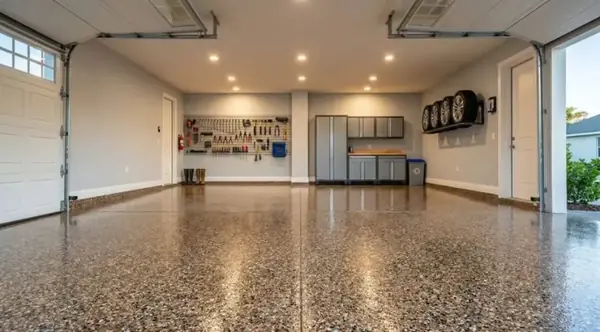
The sun is stronger here than at sea level. The EPA notes that UV intensity rises about 6 percent for every kilometer of elevation, and the valley floor sits at roughly 4,200 feet. Plain epoxy without a protective topcoat can yellow under that light, and an open garage door on long summer evenings lets plenty in. Flake floors are finished with a UV-resistant protective topcoat for that reason.
Dry air and big day-night swings
July afternoons at the airport are very dry, and the temperature drops sharply overnight. Both matter more on installation day than for the finished floor: heat and dry air shorten how long many coatings stay workable, and the slab can be warmer or cooler than the air around it. Installers plan around the slab temperature and the product’s own instructions, mix smaller batches and pick the cooler part of the day. None of this is exotic, but it explains why application skill matters as much as the product name.
Winter: Snow, Freeze–Thaw and De-Icers
Those freeze–thaw swings are the core winter problem: every melt and refreeze lets water soak into bare concrete and expand as it freezes.
Then there is what keeps the roads open. Salt Lake City spreads 16,000 to 20,000 tons of salt on city streets each winter and plows more than 1,900 lane miles. The city lists magnesium chloride and calcium magnesium acetate among the de-icers residents can use on sidewalks, steps and driveways, and Herriman sprays salt brine on its roads before snowfall. According to the National Ready Mixed Concrete Association (NRMCA), magnesium-based de-icers “can be tracked by cars and accumulate on concrete surfaces,” and de-icing chemicals make freeze–thaw scaling worse.
A well-bonded coating keeps that slush sitting on the surface, ready to be pushed or hosed out the door; bare concrete drinks it in. Coating is no cure-all, though. A slab that has already started scaling gets ground and repaired before anything goes on it, and the few feet inside the door always take the brunt. That strip has its own guide: why floors peel at the garage door.
Winter has one more local quirk. Utah’s Division of Air Quality counts about five to six multi-day inversions in a typical winter, when cold air gets trapped in the Salt Lake Valley. Garage doors tend to stay closed through those cold stretches, so slush melting off the car sits on the floor until someone moves it, and a quick squeegee pass keeps it from drying into a salty film. On any winter install, the work area is ventilated as the product instructions require.
Planning a Floor Before the First Freeze?
Book a free on-site estimate: a look at your slab, a straight talk about which system fits your garage or basement, and an exact price, with no obligation.
Under the Coating: Old Houses, New Builds and Lake Bonneville
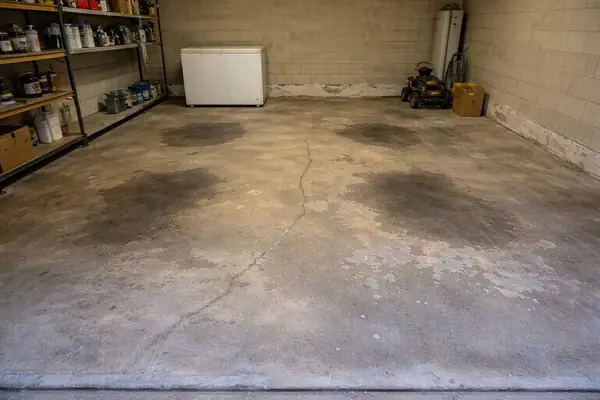
Whatever is applied can be no stronger than the concrete beneath it, and Salt Lake County’s housing covers a wide range. About a quarter of Salt Lake City’s homes were built before 1940, the biggest building decades in Millcreek and Holladay were the 1950s and ’60s, and Herriman’s median home dates to 2013 (Census ACS 2020–2024). An older slab may be perfectly solid, yet it has had years to soak up oil and pick up paint, sealer and cracks, all of which must come off or be fixed before coating. Newer slabs are cleaner but may carry a builder’s sealer or curing compound that has to be ground off.
Moisture is the other half. The valley floor is built on sediments left by ice-age Lake Bonneville, which was more than 1,000 feet deep about 18,000 years ago, and the Utah Geological Survey has mapped shallow groundwater on the west side of the valley. Basements and slabs where water collects are the most likely to push moisture up into a coating, so the slab is checked before it is coated. Coating a basement does not make it waterproof; incoming water needs a fix at its source first.
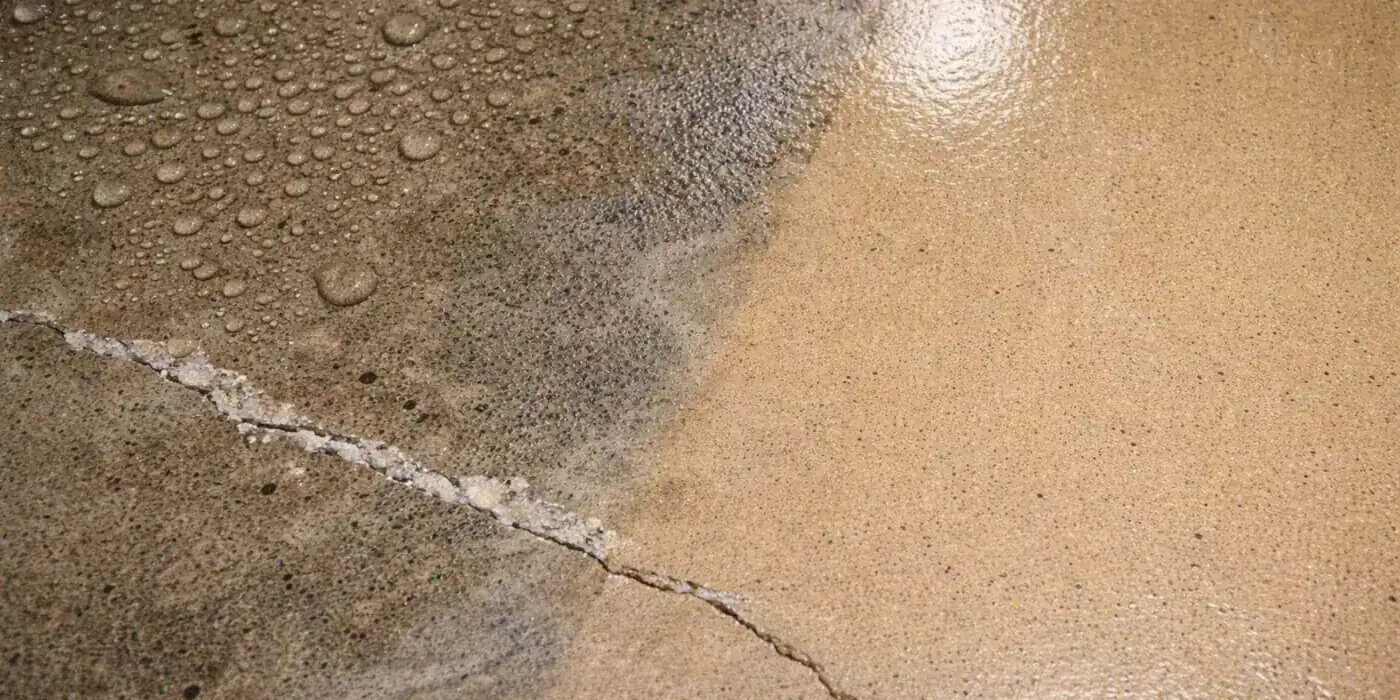
As for cracks: fine hairlines are normal in concrete and get filled during prep. An active crack, one that is still opening or shifting, is another story. No coating can hold a moving slab still, and if the installer spots signs of movement, you’ll be told up front.
Habits and Shortcuts That Cut a Floor’s Life
- Skipping the grinder. Coating spread over smooth, dusty or oily concrete has nothing to key into. Diamond grinding opens the surface so the base coat can soak in and bond.
- An unchecked slab. Rising moisture surfaces months later as blisters or lifting.
- Chips left open through salt season. Salty meltwater gets under the edge, freezes, and lifts it a little more each time.
- Store-bought kits. One thin coat over a washed slab may look fine for a while, then wear through or peel.
- The wrong cleaning habits. Acidic cleaners, abrasive pads and dragged metal wear any finish faster.
A Salt Lake City Care Calendar
- Late fall, before the first freeze: sweep out leaves and grit, hang a squeegee by the door, and get any chips repaired while the weather is mild.
- Winter: squeegee meltwater out after each storm, and hose off the door strip whenever salt dries to a white haze.
- Spring, after the last freeze: wash the entire floor with a pH-neutral cleaner so no salt residue or grit is left behind.
- Summer: sweep more often, because dry, dusty air blows grit in through the open door, and clean up oil drips promptly.
For a fuller routine, see the epoxy floor care guide; for what goes into the price of a new floor, see the Salt Lake City cost guide.
Frequently Asked Questions
How many years will an epoxy floor last in Salt Lake City?
Nobody can honestly promise a number of years. A floor that was diamond ground, checked for moisture and sealed with a protective topcoat will outlast a thin kit rolled over a washed slab. Prep, moisture, the topcoat and upkeep decide it.
Can an epoxy floor handle Salt Lake City winters?
Yes, when it is a full system on a well-prepared slab. A sound coating keeps salty slush on the surface, where it can be squeegeed and rinsed away. Trouble starts where a chip or weak edge lets meltwater underneath, usually just inside the garage door.
Will magnesium chloride or road salt hurt a coated floor?
On a sound, well-bonded floor, salt and magnesium chloride sit on top and rinse off. They do the most harm to bare concrete, such as the driveway apron, and to coatings that are already chipped or poorly bonded. Rinsing through the winter helps.
Does the sun at our elevation affect a garage floor?
It can. UV is stronger at our elevation than at sea level, and epoxy left without a topcoat can yellow in strong light. Flake floors are finished with a UV-resistant protective topcoat.
Will a coating hold a cracked slab together?
No. Hairline cracks are filled during prep, but no coating can stop a slab that is still shifting. If the installer sees signs of movement, you’ll hear about it before any work begins.
Does a floor coating keep basement moisture out?
No. Coating a basement floor does not waterproof it. The slab gets a moisture check first, and any water problem must be fixed where it starts.