Industrial Epoxy Flooring Salt Lake City: Warehouse & Plant Floors
Warehouse, manufacturing and distribution floors across Salt Lake County, built with urethane cement or epoxy systems and quoted per project after a free site visit.
Warehouse and Plant Floors in Salt Lake County
Warehouses, manufacturing plants and distribution centers ask more of a floor than a store or office does, so they get their own page here; retail and office spaces are on our commercial floors page. Think aisles that take forklift turns all shift, production areas that see oils and degreasers, and shops where something heavy eventually gets dropped.
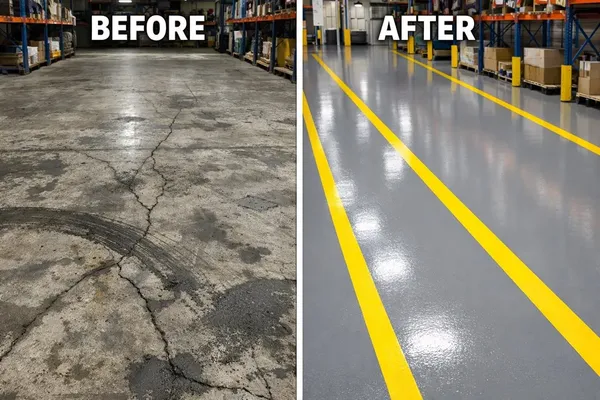
Each area gets its own system. Urethane cement suits rooms that run hot and wet or get washed down, while epoxy systems suit dry aisles and storage. Slip-resistant additives go where floors get oily or wet, and safety striping can mark walkways, forklift lanes and hazard zones on the finished floor.
Salt Lake County weather adds to the load. NOAA's airport normals show about 52 inches of snow a year, and trucks and forklifts drag road salt and snowmelt through the dock doors for months. Every job therefore starts with a site visit: the slab is checked for moisture, cracks and failed joints are repaired, the surface is diamond ground or shot blasted, and the work can be phased if the building has to keep running.
Retail, restaurant or office space instead? Our commercial floors page is the better place to start.
What a Plant Floor Has to Take
Forklifts, chemicals, wash-downs and a winter of road salt: the system is matched to each room and to your slab.
Chemicals
Chemical Resistant
Cutting fluid, hydraulic oil, fuel and degreasers all end up on a plant floor. The resin and topcoat are chosen for what actually spills in your building, and chemical-resistant specialty systems are available when standard epoxy is not enough.
Traffic
Built for Forklift Traffic
Forklifts pivot on the same spots and pallet jacks wear the same lanes every shift. A firmly attached, thick system stands up to that far better than bare concrete, which dusts and breaks down under it.
Grip
Anti-Slip Where It Matters
Slip-resistant additives, silica sand among them, go where floors get slick: wash-down areas, dock doors in a snowstorm, oily maintenance bays.
Lines
Safety Striping
Walkways, forklift lanes, hazard zones and color-coded areas can be striped on the new floor. Mark up a floor plan at the site visit and it goes into the quote.
Specialty
ESD and Specialty Systems
ESD flooring for static-sensitive work, antimicrobial additives and joint sealants are available on request. Tell us what the room does and you'll get a plain answer on what fits.
Recoat
Planned for the Long Run
Prep is what makes a plant floor hold: grinding, joint repair and a moisture check before any coating. When the busiest lanes wear, the topcoat can often be renewed without tearing out the floor.
Why coatings let go →From Walk-Through to Working Floor
Five steps to a floor your team can work on, phased if the building has to stay open.
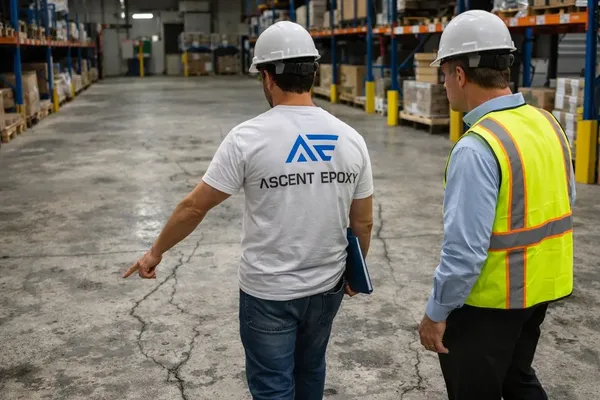
Facility Assessment
The crew walks the building with you, checks the slab for moisture, notes cracked joints and damaged areas, asks which chemicals the floor sees and maps where forklifts and people move. Schedule yours free.
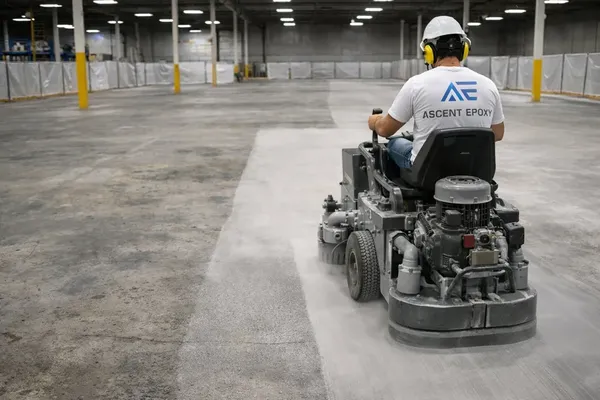
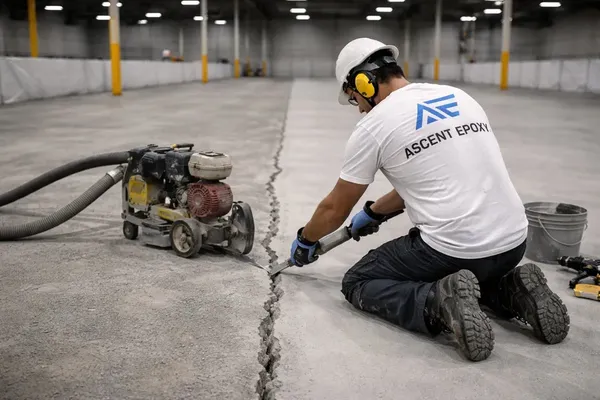
Industrial Slab Preparation
The floor is diamond ground or shot blasted, which also strips old coatings. Cracks, chipped patches and broken joint edges are repaired and joints are sealed, so the new system sits on sound concrete.
Primer
A primer seals the ground concrete and ties it to the coats above. If the moisture check shows a problem, you hear what that means for the system before anything else goes down.
Coating System Application
Each area gets its own build: urethane cement where it runs hot and wet, thick-build epoxy for busy aisles, a chemical-resistant topcoat where spills happen, and slip-resistant additives in wet or oily zones. Safety striping goes on at this stage.
Curing & Handoff
Cure times depend on the product and the slab temperature, which differ a lot between a cold January warehouse and a hot July one, so the schedule allows for it. At handoff the crew goes over cleaning and upkeep for your system.
Ready to Start? Step 1 Is Free.
Book a free site visit to go over the floor, the traffic and the chemicals.
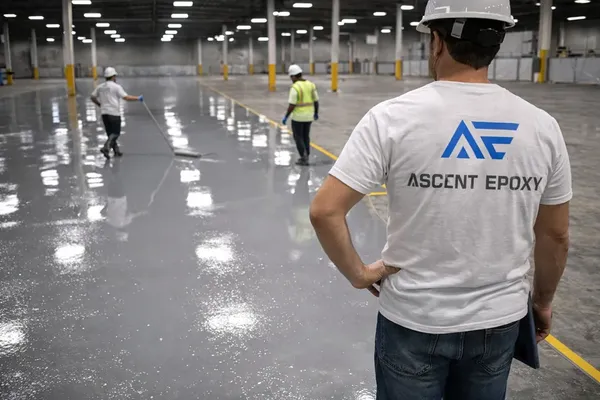
Industrial Finish Examples
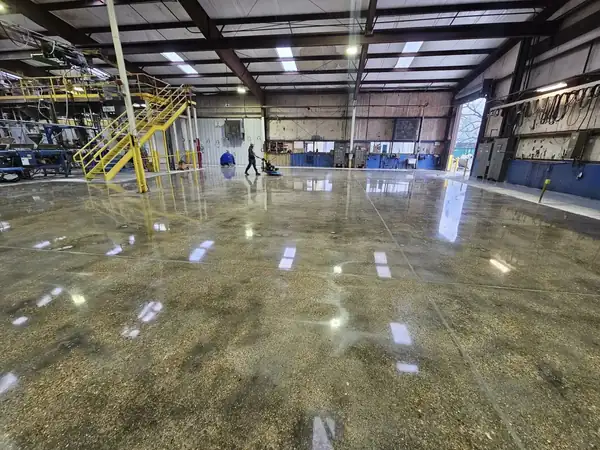
A high-gloss production hall here; the full gallery adds striped warehouse aisles and an auto service bay.
Industrial Floor Questions
Answers for Salt Lake County plant, warehouse and facility managers.
Facilities across Salt Lake City and the rest of the county, including:
- Warehouses and distribution centers
- Manufacturing and production areas
- Food and beverage processing rooms
- Cold storage
- Auto and fleet service bays
- Aircraft hangars
Each area gets a system matched to its loads, chemicals and temperatures, and every job is quoted per project after a free site visit.
Mostly through temperature. Coatings have to go down within the product's temperature range, and a slab by an open dock door in January can be far colder than the air inside. Summer is the reverse: hot, with very dry afternoons.
So the slab is checked before work starts, and install days are planned around the temperature and the product's own instructions.
Yes, within limits you'll hear up front. Standard epoxy systems resist oil, grease, fuel and most cleaning chemicals.
Concentrated acids or strong solvents call for a specialty chemical-resistant system. List exactly what is used at the site visit, and if no system is a good fit for it, you'll be told plainly.
Yes. Safety striping and traffic markings can go on the new floor, for example:
- Pedestrian walkways
- Forklift lanes
- Hazard and restricted zones
- Equipment and storage outlines
- Exit routes
- Color-coded areas
Mark up a floor plan at the site visit and the striping is included in the per-project quote.
That comes down to the square footage, the condition of the slab and the system. A small shop can be quick, while a big warehouse takes longer and is often phased.
Phasing keeps part of the building working while another section is coated. The timeline comes with your estimate, so shifts and deliveries can be planned around it.
Preview your facility floor.
Try finishes on a floor like yours and get a typical Salt Lake County price range with your free-estimate request. Industrial floors are quoted per project after a site visit.
Open Floor Studio →