The Quick Verdict
For a garage that takes a car every day, or a basement you're turning into living space, a coating put down by a professional crew tends to pay its way in Salt Lake County, provided the concrete underneath is in good shape and properly prepared. It costs more than paint or a sealer, it can't stop a crack that's still opening, and it does nothing to keep groundwater out. Its strengths are protecting the slab through salt season, making cleanup quick and making a plain concrete room look finished. Here's what drives the price, the payoff and the drawbacks, how it stacks up against paint, sealer and tiles, and the situations where we'd say wait.
What Drives the Price
We don't price floors from a chart. Each one gets a free on-site look first, since the slab and your choices set the figure. The main factors:
| Factor | Why it matters |
|---|---|
| Square footage | A bigger floor takes more product and more hours; for scale, a typical two-car garage runs about 400 to 500 square feet |
| Condition of the concrete | Cracks to fix, spalled patches and any old paint or sealer to strip all add preparation |
| System and look | Flake, metallic or solid color, and the sheen of the topcoat |
| Add-ons | Slip-resistant texture, steps, edges and extra repair work |
| Business floors | Each commercial or industrial job gets its own quote after a site visit |
Concrete that is clean and solid needs the least preparation. For a closer look at each factor, see our Salt Lake City cost guide.
The Payoff
Salt stays on the surface
Between the first frost, usually around Halloween, and the last one in early April, every drive home brings slush onto the slab. Salt Lake City by itself spreads 16,000 to 20,000 tons of road salt in a typical winter, and NRMCA, the ready-mixed concrete industry's association, points out that magnesium-based de-icers travel on vehicles and collect on concrete. Bare concrete drinks that salty water in, and de-icers worsen the surface flaking known as scaling. On a coated slab the slush stays on top until you push it out the door.
Tough in daily use
A properly applied system is durable and stands up to chemicals and stains far better than paint. Daily parking, a dropped wrench or a dripping oil pan do far less harm to it than to raw or painted concrete. Heat and sun are part of the picture as well: NOAA's normals for the airport show roughly 62 days a year at 90°F or above, and at our elevation the sun is stronger than at sea level, which is why flake floors here carry a UV-resistant protective topcoat.
Quick cleanups
Drips, tracked-in grit, sawdust and paint spills can't sink into a sealed surface, so a damp mop, a garden hose or a squeegee takes care of almost everything.
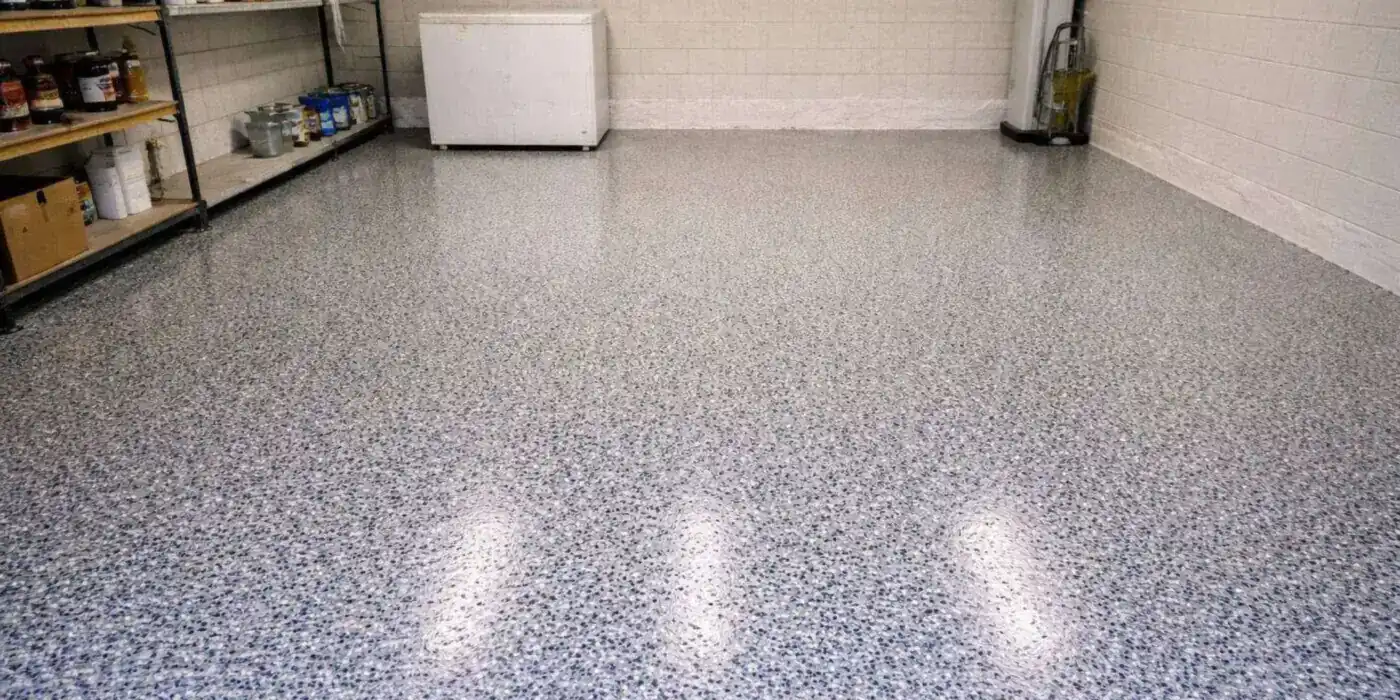
A finished-looking room
Roughly one home in four in Salt Lake City dates from before 1940, and much of the surrounding county went up after the war or in the 1970s and '80s. Many of those garages and basements show their age in oil marks and patched spots. A flake floor, in the color and flake density you pick, gives the room a clean, finished look.
About two days of work
Most garage floors are installed over about two days, and the installer lets you know when you can walk on the floor and when you can park on it.
Traction when it's wet
Ask for a slip-resistant additive and a floor that collects snowmelt or basement damp keeps its footing.
The Drawbacks
It isn't a small purchase
A professional coating is a real outlay. When the floor's problems are only cosmetic and the household budget is stretched this year, putting it off is a sensible call.
Preparation decides the result
Coatings grip concrete that is clean and opened up, and nothing else. Every garage floor is diamond ground first, cracks get repaired and any old coating or sealer is removed. Floors that skip that step are the ones that peel, so a quote that drops the prep isn't really a saving.
A damp slab has to wait
Moisture moving up through concrete can lift a coating from below. Slabs are checked for moisture before anything is applied, and if the reading says not yet, you'll be told rather than sold a floor that lets go.
Ground movement is a separate problem
The valley floor is made of sediment from ice-age Lake Bonneville, and some slabs crack because the soil beneath them shifted. A coating protects and finishes the surface; it isn't a structural repair and can't bridge a crack that keeps opening. If yours is still moving, that comes up before any coating does.
No help against groundwater
The Utah Geological Survey has mapped shallow groundwater across the west side of the valley, and a high water table can flood basements. A coated basement floor makes the cleanup far easier, but the water still has to be dealt with at its source.
Gloss and water
A shiny surface can turn slick under water or snowmelt. The slip-resistant additive solves exactly that, so request it wherever the floor gets wet.
Coating Versus Paint, Sealer and Tiles
| Choice | Surface prep | Winter salt and daily wear | Do it yourself? |
|---|---|---|---|
| Leave it bare | None | Salt water soaks in and marks the slab | — |
| Clear sealer | A wash | Wears off over time and needs another coat | Yes |
| Floor paint or a kit | Rarely ground | Tends to lift first by the garage door | Yes |
| Mats or interlocking tiles | None | Tops hold up; grit and water gather below | Yes |
| Professional coating | Diamond grinding plus repairs | Sealed surface that resists chemicals and stains | No |
Kits and paint seem like the thrifty route, yet they go on thin over concrete that was never ground, and the first place they let go is usually the strip inside the door where slush pools. Repainting over and over erases whatever you saved.
Try finishes on a floor like yours and get a typical Salt Lake County price range with your free-estimate request.
Open Floor Studio →Who Gets the Most From It
- Daily drivers. If the car comes in salty in January and hot in July, the floor gets a workout, and that's the job a coating is built for. From one homeowner's Google review: “I love my new garage floor epoxy. The whole process was painless and the floor looks amazing.” (Susie T., Google review)
- Basement projects. A bright, wipe-clean floor pulls a basement into the rest of the home, once the concrete has passed its moisture check.
- Long-term owners. The more years you live with the floor, the more the protection and quick cleanups add up.
- Solid, dry concrete. When the slab is in good condition, preparation is routine.
- Workshops and hobby rooms. Spills, sawdust and dropped tools come up without a fight.
Not Sure Your Floor Is Ready?
At a free on-site estimate the installer measures the floor, looks over the slab and gives you a straight recommendation, even when it’s “not yet.”
Reasons to Wait
- Cracks that keep growing. Sort out the cause, then coat.
- Water in the basement. Solve the water problem before you think about the floor.
- A quick sale on a tight budget. A thorough scrub may help a listing just as much.
- Concrete that's being replaced. There's no point coating a slab that is about to be broken out.
- A no-prep paint job. That isn't the service, and it wouldn't hold up.
Where We Land
If you own a home in Salt Lake County, use the garage every day or want more out of the basement, and the concrete is in reasonable condition, a coating done the right way earns its place: ground, repaired, moisture-checked and sealed with a topcoat that suits the room. What doesn't earn its place is the shortcut, a thin coat rolled over concrete nobody prepared.
To get a read on your own floor, call (801) 618-0565 or request a free estimate. A homeowner wrote this about the visit in a Google review: “We appreciated the time the owner took in answering all our questions when they came out to measure our floor. They did our garage floor and looks amazing. Great company to work with.” (Marisa K., Google review)
Frequently Asked Questions
Is an epoxy floor worth the money in Salt Lake City?
For most daily-use garages and basements being finished, yes, provided the concrete is sound and gets proper prep. Floor size, slab condition and the finish you pick set the price, which is why every floor gets a free on-site visit first.
What does a 3-car garage floor cost in Salt Lake City?
That comes down to the exact square footage, the state of the concrete, the system and finish you want and how much prep the slab needs. The installer measures and inspects the floor at a free estimate with no obligation, then prices your garage. Call (801) 618-0565 to book it.
Are DIY epoxy kits a good idea?
Not for a garage you park in every day. A kit goes on thin over concrete that hasn't been ground, so it usually starts lifting near the door where winter slush collects, and redoing it again and again cancels out the savings.
Can a coating repair a cracked slab?
Cracks get repaired during prep, but no coating can hold a crack together if the slab is still moving. If the ground underneath is shifting, you'll hear that before any coating goes down.
Will epoxy keep water out of my basement?
No. You get a sealed floor that cleans up easily after water comes in, but it won't stop flooding or groundwater. Basement slabs get a moisture check before they're coated.
How long does installation take?
Most garage floors are installed over about two days. The installer will tell you when you can walk on the floor and when it's ready for the car.
Related Articles
Epoxy Flooring Cost in Salt Lake City: What Sets Your Price (2026)
Size, slab condition, system and finish: the factors behind a garage or basement floor quote in the valley.
How Salt Lake City’s Snow, Salt and Sun Test an Epoxy Floor
How road salt, freezing nights and 90-degree summers affect a coated floor in Salt Lake City.
Why Salt Lake City Epoxy Floors Peel at the Garage Door
The strip just inside the overhead door takes the most abuse, and it's where a poorly prepared coating gives up first.