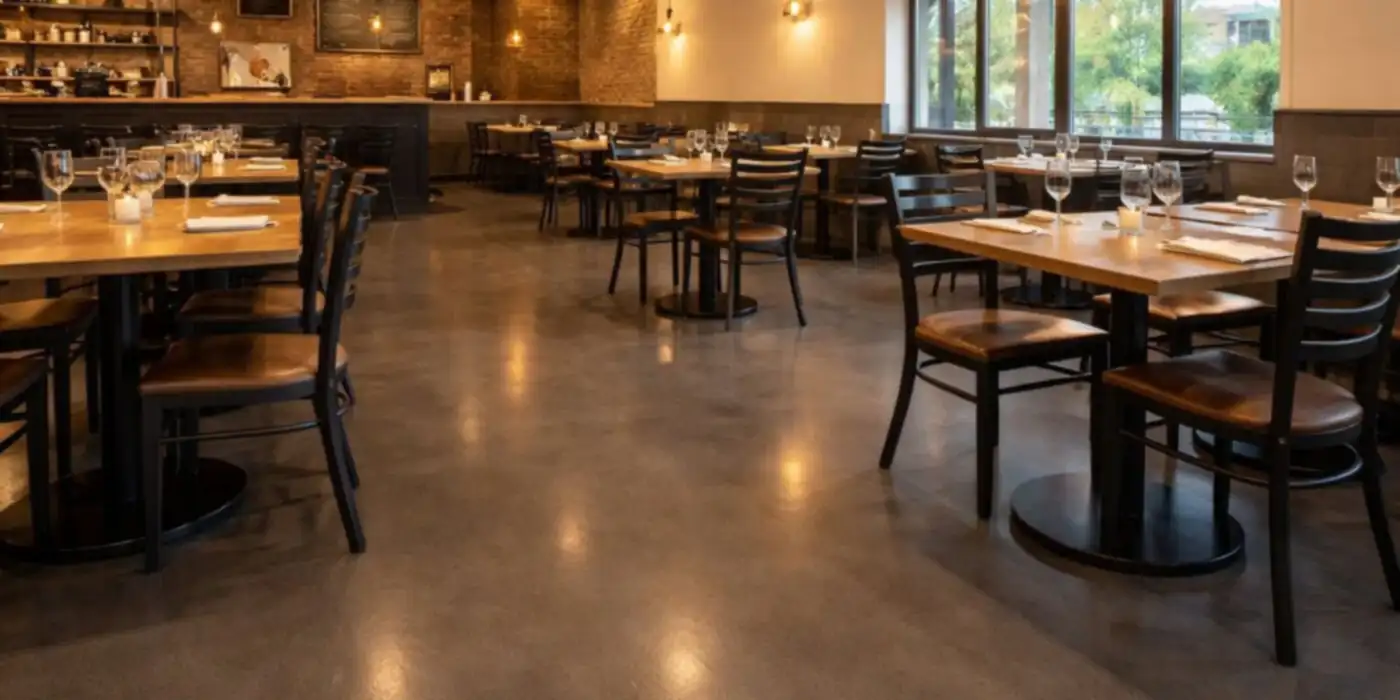
A business floor gets judged twice a day: when the doors open, and again when the mop comes out at closing. Ascent Epoxy Salt Lake City coats concrete floors for warehouses, showrooms and stores, offices, auto shops and restaurant kitchens across Salt Lake County, from downtown Salt Lake City out to West Valley City and West Jordan and down the I-15 corridor to Draper. Each commercial floor is quoted on its own after a free on-site visit, because a small café kitchen and an open storage building have little in common beyond the concrete.
This guide covers which coating suits which kind of space, how winter salt and the valley's dry summers show up on a commercial slab, how the work gets scheduled, and what goes into the number on your estimate. To talk it through now, call (801) 618-0565.
Which Businesses We Coat
The installer we work with coats commercial and industrial concrete as well as homes, and the business floors it coats fall into a handful of space types: warehouses and storage buildings, retail floors and showrooms, auto shops and service bays, restaurants and commercial kitchens, and offices. Whatever the size, the first conversation is the same. What rolls across the floor? What gets spilled on it? How is it cleaned, and for how long can the room be out of use?
Most of our Google reviews come from homeowners rather than businesses, but what they mention is what a business owner cares about too:
“I paid them to do my epoxy flooring and wasn't disappointed with the quality of work I received from them. I didn't have to follow up with a complaint or go out of my way to get my epoxy flooring the way I wanted it. Very professional experience overall! I highly recommend them for your Epoxy Flooring needs.”
— Paul R., Google review
Warehouses and Storage Floors
Uncoated warehouse concrete gives off dust, soaks up whatever leaks from a pallet and wears paths wherever equipment turns. A coating puts a hard, sealed wear surface on top of the slab: the floor sweeps clean, spills wipe up instead of sinking in, and a lighter color helps a tall, dim building feel brighter. Safety striping and traffic markings can be part of the same job, with forklift lanes, walkways, loading zones and keep-clear areas laid into the floor rather than taped down afterwards.
Prep decides whether any of that lasts. Old sealers, curing compounds, tire marks and failed coatings come off first, by diamond grinding or shot blasting depending on what is on the slab. Cracks and damaged spots are repaired, joints can be sealed, and the concrete is checked for moisture before a coating goes down. Heavier production floors are covered on our industrial epoxy flooring page.
Showrooms, Retail Floors and Offices
Customers see the floor before they see what is sitting on it, and a stained, patched slab says something about a business even when nobody mentions it. Three looks work well in public-facing rooms. Metallic epoxy gives a showroom a fluid, polished-stone character. Flake reads tidy and disguises everyday scuffs. Solid color keeps attention on the merchandise. The topcoat can be matte, semi-gloss or high-gloss, so the sheen can suit the lighting and the brand.
Offices ask less of a floor in wear and more in looks and upkeep: rolling chairs, a vacuum every night, coffee on the way to the desk. Solid color or flake is the usual answer there. In stores, the harder question is usually timing, because an opening date rarely moves and an existing shop can't give up many trading days. That is covered under planning, below.
Restaurants and Commercial Kitchens
A kitchen floor gets hot water, fryer grease, food acids and a mop several times a shift. For that kind of room the installer uses urethane cement, a heavy-duty commercial system made for hot, wet spaces where a standard epoxy coating would struggle. Dining rooms and front counters can carry something more decorative, since they see shoes rather than boiling water.
Wet floors need grip, and slip-resistant additives are available for exactly that. The amount of texture is set room by room: more behind the line and at the dish station, less in a dining area where chairs slide. If your health inspector or landlord has requirements for floor finishes, bring them to the site visit so the quote is written around them.
Auto Shops and Service Bays
Service bays collect motor oil, coolant, brake fluid and dropped tools, and in July they take vehicles rolling in off I-15 or Bangerter Highway when the normal afternoon high at the airport is 94°F. A bay coating needs strong chemical and stain resistance and a tough topcoat, laid over a slab that has been ground clean of years of oil. Flake hides the wear of a working shop well; solid colors make a dropped bolt easy to spot. If a customer waiting area or sales floor sits next door, it can take a more decorative finish than the bays, so one building often ends up with two systems.
A word on hot tires: they are hard on every floor coating, and nobody can honestly promise that a tire fresh off the freeway will never mark a floor. What helps is good prep, the right topcoat and wiping up spills before they sit.
Systems at a Glance
This table is where the conversation usually starts. The final specification comes after the site visit, once the slab and the way the room is used have been seen in person.
| Space | What the floor deals with | Typical starting point | Finish choices |
|---|---|---|---|
| Warehouse / storage | Pallet jacks, forklifts, dust, spills | Epoxy coating system with a tough topcoat | Solid color with safety striping and marked lanes |
| Showroom / retail | Foot traffic, carts, first impressions | Metallic or flake epoxy under a clear topcoat | Metallic colors, flake blends or solid color; matte to high-gloss |
| Restaurant / commercial kitchen | Hot water, grease, constant wet cleaning | Urethane cement | Textured, with slip-resistant additives |
| Auto shop / service bay | Oil, fluids, hot tires, dropped tools | Chemical-resistant epoxy base and topcoat | Flake or solid color |
| Office | Rolling chairs, nightly cleaning, appearance | Epoxy system; polyaspartic systems are also available | Solid color or flake |
Try finishes on a floor like yours and get a typical Salt Lake County price range with your free-estimate request.
Open Floor Studio →Valley Weather and a Business Floor
Salt at the doors
Salt Lake City spreads 16,000 to 20,000 tons of salt on its streets in a typical winter, and its snow-removal page lists magnesium chloride among the de-icers residents can use on walks and driveways. The concrete industry group NRMCA notes that magnesium-based de-icers can be carried in by vehicles and build up on concrete surfaces. For a business, that means the entry, the dock apron and the first bay inside an overhead door take the worst of it every winter. Those are the spots that get the toughest finish, and where walk-off mats and a squeegee earn their keep from November into early April.
Freezing nights and dry, hot summers
NOAA's airport normals show about 112 nights a year at or below freezing and roughly 52 inches of snow, and Salt Lake City's building code rates concrete weathering exposure as severe. Summer swings the other way: about 62 days a year reach 90°F, and the air is very dry. Neither extreme suits a rushed install. A careful crew watches the slab temperature as well as the forecast, and follows each product's own instructions on when it can be applied and how long it needs, rather than a rule of thumb.
Altitude and sunlight
The valley floor sits at roughly 4,200 feet, and the EPA notes that UV intensity rises about 6 percent for every kilometer of elevation. Sun pouring through a storefront window or an open bay door is part of the reason flake floors here are finished with a UV-resistant protective topcoat.
Planning the Work Around You
For most businesses the coating isn't the hardest part of a new floor; the days the room can't be used are. So timing gets settled first:
- Tell us your window. Give us the days the space can be empty, and the estimate will say plainly whether the system you need fits inside them.
- Ask about sections. On a larger floor it may be possible to coat one area at a time so the rest of the building keeps working. Whether that works depends on the layout and the system, and it's settled at the site visit.
- Know when it's ready. When a floor can take foot traffic, carts and vehicles depends on the product and the conditions on the day, so you get those times for your system rather than a generic promise.
- Clear the room. Who moves shelving, racks and stock is agreed in advance, so nobody arrives to a room that isn't ready.
Planning a Commercial Floor in Salt Lake County?
Tell us about the space and your timing. The installer measures and quotes in person after a free, no-obligation site visit.
What Goes Into a Commercial Quote
Commercial and industrial floors are quoted one project at a time, after a site visit. A light-use office and a urethane-cement kitchen sit too far apart for a single figure to mean anything. What moves a quote:
- Area and layout. One open room goes faster than several small ones broken up by drains, columns and doorways.
- The slab. Old coatings, sealers, oil, cracks and damaged concrete all add prep time.
- System and finish. Flake, metallic, solid color and urethane cement are different materials with different labor.
- Extras. Slip-resistant texture, safety striping and marked lanes.
- Timing and access. Work done in sections takes more planning than an empty building.
The estimate is free, on site and carries no obligation. Homeowners can read our Salt Lake City epoxy flooring cost guide on what sets the price of a garage or basement floor, and the commercial epoxy flooring service page has more on the systems.
Frequently Asked Questions
What does commercial epoxy flooring cost in Salt Lake City?
Every commercial floor is quoted on its own after a free site visit. The size and layout of the space, the condition of the slab, the system and finish, and your timing all change the number, so we don't publish a per-square-foot figure.
Can the floor be done without closing the business?
Sometimes. Depending on the layout and the system, a larger floor may be coated one section at a time while the rest stays in use, and a small room can be booked for your quietest days. You get the timing for your system at the site visit.
What coating works best in a restaurant kitchen?
For hot, wet kitchens the installer uses urethane cement, a commercial system made for hot water, grease and constant wet cleaning. Slip-resistant additives give the surface grip where the floor is often wet.
Is a commercial epoxy floor slippery?
A smooth, glossy finish can be slick when wet. Slip-resistant additives are available, and the amount of texture is matched to the room, so a kitchen or an entry gets more grip than an office.
What goes on a warehouse floor?
Usually an epoxy coating system with a tough topcoat over a diamond-ground slab, plus safety striping and marked lanes if you want them. The exact build is confirmed once the slab has been checked.
Do you coat auto shops and service bays?
Yes. A bay needs a chemical- and stain-resistant coating over a slab ground clean of old oil. Flake and solid color both work, and a waiting area or sales floor next door can take a more decorative finish.
Related Articles
Epoxy Flooring Cost in Salt Lake City: What Sets Your Price (2026)
What sets the price of a Salt Lake City garage or basement floor, and what pushes a quote up or down.
How Salt Lake City’s Snow, Salt and Sun Test an Epoxy Floor
Freezing nights, road salt, dry heat and strong sun: how the valley's weather shows up on a coated floor.